




Dusty Merritt
Estate-sale scout. Your closet's past life is his present.
Real Vintage or Modern Repro? The Faded-Print Test
Crackle patterns, collar tags and single-stitch hems — a five-clue field guide for telling a genuine old graphic tee from a convincing reproduction.
Both are allowed
A modern reproduction of a seventies print is a perfectly good purchase — often on better cotton, in your size, without moth history. What matters is knowing which one you are holding, because price, care and bragging rights all depend on it. The vintage rack rewards five specific checks, and none of them require touching a price guide.
Clue one: how the print aged
Old screen prints crack in the fabric's own rhythm — a fine spiderweb of crazing that follows decades of folding, concentrated where the shirt actually creases. Distressed reproductions fake this with printed crackle: the cracks are in the ink layer as designed, uniform across the graphic, and often the same on every shirt in the stack. Real fade is random. Manufactured fade is a pattern.
Clue two: the collar tag
Tag design dates faster than any other detail. Printed-on tags, specific brand logos and country-of-origin marks all moved in eras — single-company tags with older logos, union marks and printing countries that no longer manufacture are all strong age signals. A modern blank tag under an older-looking print is the reproduction's signature.
Clue three: the stitching
- Single-stitch hems — one row of straight stitching at the sleeve and bottom hems — were standard before the mid-nineties in most American production. Double-needle stitching suggests later manufacture.
- The collar itself. Older tees often have substantial, flat-lying collars with exposed seam binding; thin wavy collars are modern cost-cutting.
Clue four: the fabric
Decades of washing change cotton's hand: old tees feel thin, soft and slightly limp with a matte dryness that cannot be faked by acid wash. New cotton has body and a faint sheen. Weight drops with age too — a tee that reads heavyweight in photos but feels feather-light in hand has lived through something.
Clue five: the logic test
Does the graphic's history match the shirt's condition? A forty-year-old print on a pristine body, or a modern cut wearing a distressed graphic, both fail the sniff test. Reproductions are honest products with dishonest aging — and now you can tell the difference in under a minute.
As Worn in This Note
Shop the Look
American Classics
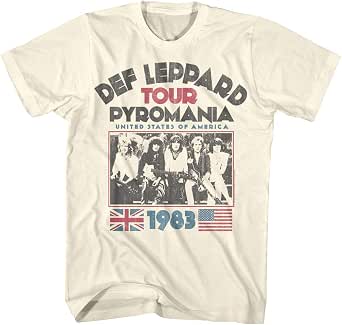
American Classics Def Leppard Pyromania Tour 1983 T Shirt Natural | Officially Licensed Def Leppard Tee, Distressed Vintage Style Graphic, Designed and Printed in the USA, Unisex Crew Neck Fit

Tee Luv
Tee Luv Men's Tootsie Roll Pop Mr Owl Wanna Lick Candy Mascot T-Shirt | Retro 70s Tootsie Pop Cartoon Bird Mascot T-Shirt, Distressed Lollipop Snack Graphic Tee, Poly-Cotton Short Sleeve Shirt
As an Amazon Associate, we earn from qualifying purchases.
Price and availability are subject to change on the retailer's site.
More Like This

One Print, Five Cities: Graphic Tees That Travel Well
 Emiko Tanabe

Indie Artist Tees: Small Studios, Big Prints
 Linnea Holt

Graphic Tees After Dark: The Evening Print
 Talia Mendes

Western Graphic Tees: Rodeo Prints, City-Broken
 Andre Beaumont

Plus-Size Graphic Tees: Print Scale and Drape, Solved
 Davina Cross

Heavyweight or Thin? What Fabric Weight Does to a Print
 Colin Marsh